
AI vs Software Developers: Do We Still Need Human Engineers in 2026?
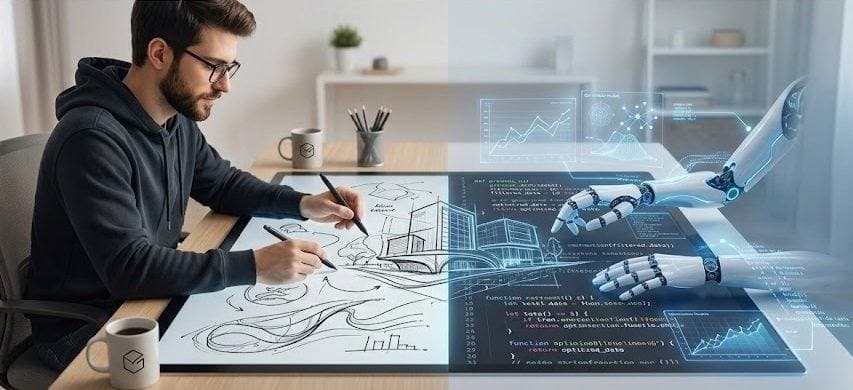
With the rapid acceleration of artificial intelligence coding assistants and the democratization of no-code platforms, a provocative question has emerged in boardrooms and startup hubs alike. In the ongoing discussion of AI vs software developers, many business leaders are wondering: do we still need human engineers to build our digital products?
If you view developers simply as "code monkeys"—people who translate human instructions into syntax—the answer might seem to be "not for long." However, this perspective fundamentally misunderstands what software engineering actually entails. The truth is, the work of an engineer has never been limited to merely writing code.
Here is why top-tier engineering talent is more critical today than ever before, and why the "AI vs software developers" narrative is actually about collaboration, not replacement.

1. Problem Solving vs. Syntax Generation
Writing code is merely the final, and often the easiest, step in a much longer and more complex process. Before a single line of code is committed to a repository, an engineer must do a tremendous amount of critical thinking.
Understanding the Business Domain: What is the actual problem we are trying to solve? Often, the feature requested by stakeholders is not the feature actually needed by the end-users. Human empathy and business acumen are required to bridge this gap.
Architecting for Scale: How will this system behave when it has 10 concurrent users versus 10 million users?
Navigating Edge Cases: What happens if the network drops mid-transaction? What if a user inputs malicious or unexpected data?
When we look at AI vs software developers, AI can certainly generate a function to sort a list or build a UI component in milliseconds. But AI cannot sit in a meeting, listen to a stakeholder's vague description of a workflow problem, and architect a secure, scalable, and cost-effective system to solve it.
2. System Architecture and Integration
Modern software is rarely a standalone monolith. Today's applications are living ecosystems comprised of third-party APIs, microservices, legacy databases, cloud infrastructure, and complex state management.
A significant portion of a senior engineer's job involves orchestration and systems design:
Designing how different disparate systems communicate securely and efficiently.
Choosing the right database paradigm (SQL vs. NoSQL) based on specific read/write patterns.
Managing cloud infrastructure and automated deployment pipelines (CI/CD).
While tools can write the glue code, a human engineer must design the overarching blueprint. In the debate of AI vs software developers, we must remember that poor architectural decisions made early on lead to technical debt that can bankrupt a project months or years down the line. AI doesn't understand your budget constraints or your three-year product roadmap; a lead developer does.

3. Security, Compliance, and Risk Management
In a world of strict data privacy laws (like GDPR and CCPA) and increasingly sophisticated cyber threats, deploying software is a high-stakes game. A single data breach can destroy a company's reputation and lead to massive fines.
Engineers are the first line of defense. They must deeply understand:
How to sanitize inputs to prevent SQL injection, XSS attacks, and other vulnerabilities.
How to implement robust authentication and authorization (e.g., OAuth, JWT) tailored to business roles.
How to ensure sensitive user data is encrypted both at rest and in transit.
You cannot rely on an automated tool to take legal and ethical responsibility for user data. Security requires human vigilance, critical thinking, and a deep understanding of evolving threat vectors. This is a critical point where the "AI vs software developers" argument falls flat: AI assumes no liability.
4. Maintenance, Debugging, and the Real World
Creating brand new software is relatively easy; maintaining it in a production environment is incredibly hard.
When a production server goes down at 3:00 AM on a Black Friday sale, or when a bizarre race condition only occurs under specific, highly concurrent circumstances, you need an experienced engineer. Debugging complex distributed systems requires a forensic mindset. It involves diving into logs, reproducing obscure state changes, and understanding the intricate interactions between memory, network latency, and CPU limits.
AI can suggest fixes for isolated syntax errors, but diagnosing a memory leak across a multi-node Kubernetes cluster requires the intuition and experience of a seasoned developer.
The Evolution of the Developer: Collaboration, Not Competition
So, when it comes to AI vs software developers, do you still need human engineers? Absolutely.
However, the role of the developer is evolving rapidly. As artificial intelligence takes over the boilerplate, syntax generation, and repetitive tasks, engineers are being elevated. They are transitioning from "code writers" to systems thinkers, product architects, and technical strategists. The most successful teams in the future will not be those who replace developers with AI, but those where developers use AI to achieve 10x productivity.
At Moocky, we don't just write code. We partner with businesses to solve complex problems, design resilient architectures, and build digital products that scale. We leverage the latest AI tools to speed up delivery, but we rely on our senior engineers to guarantee quality, security, and architectural integrity.
If you are looking for a technical partner who understands the big picture and the nuances of the modern tech landscape, let's talk.
Looking for an engineering team that thinks beyond the code? Discover our nearshore development services and see how we can bring your vision to life.